

TL;DR
- Cost Change: Anthropic has released Fable 5.1 and is cutting cache reads from $1 to $0.25 per million tokens while leaving ordinary input and output prices unchanged.
- Access Split: Fable 5.1 is broadly available, while invitation-only Mythos 5.1 serves enrolled US life-sciences participants and Anthropic’s Claude Security service.
- Workload Effect: Anthropic estimates 25 percent lower typical workload costs and up to 45 percent for cache-heavy agents, not a blanket 75 percent saving.
- Migration Risk: New API behavior can break stored reasoning, forced tool calls, and cross-model handoffs, so version changes require integration testing.
AI developer Anthropic released Claude Fable 5.1 and Claude Mythos 5.1 on September 1, cutting Fable’s prompt-cache read price by 75 percent while keeping Mythos behind an invitation boundary. The lower rate matters most to API customers who repeatedly reuse long instructions or project context. Fable is available on paid plans, while Mythos serves enrolled US life-sciences participants and Anthropic’s Claude Security service.
The two names describe the same underlying model under different safeguards, not separate performance tiers. Cheaper repeated context can reduce the cost of persistent agents, while fresh input and generated output remain expensive and developers adopting the new version face API and data-governance limits.
Anthropic says Fable 5.1 is better at long-horizon coding, scientific research, and knowledge work. One result comes from Terminal-Bench-Science 0.1, a 70-workflow agent test whose task-specific graders check scientific artifacts. On Anthropic’s run, Fable 5.1 received a 52.6 percent resolution rate, compared with 24.7 percent for Fable 5.
What the Price Cut Actually Covers
A prompt cache lets an application store a large, repeated prefix, such as system instructions, a codebase summary, or tool definitions, and reuse it in later requests. Fable 5.1 charges $0.25 per million tokens for a cache read, down from $1 for Fable 5. That arithmetic produces the 75 percent headline reduction.
The rest of the token pricing does not receive the same cut. Fresh input remains $10 per million tokens and generated output remains $50 per million. Cache writes, which create or refresh the stored prefix, are also billed separately and were not part of the reduction. The lower read rate therefore has the largest effect when an application repeatedly reuses substantial context, while a one-off request with mostly new input may see little change.
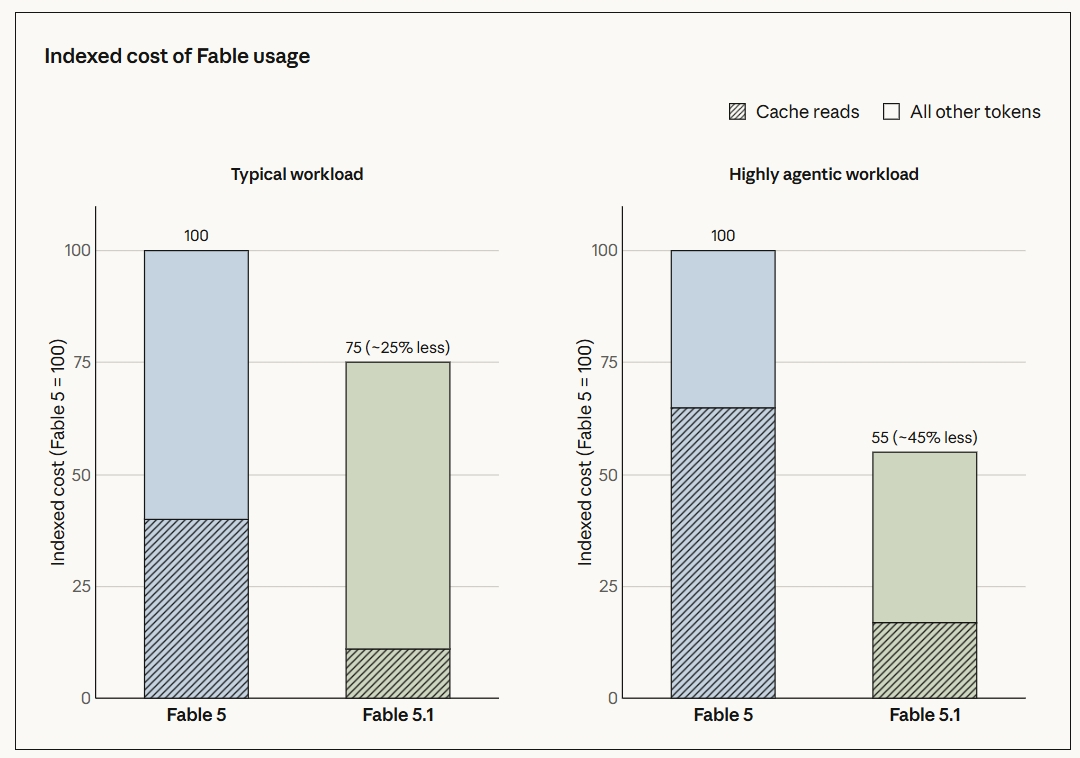
Anthropic modeled that mix using four weeks of August traffic at the default effort setting. It estimated about 25 percent lower costs for a typical Fable workload and as much as 45 percent for highly agentic workloads. Those are company estimates, not guaranteed invoice reductions or independent production measurements. The difference between 75, 25, and 45 percent is the difference between one token category’s unit price and the composition of an entire job.
Subscription access follows a different price scheme. Pro, Max, Team, and Enterprise plans provide access through allowances or usage pools, while API requests use token billing. The 75 percent figure does not mean a Claude subscription became 75 percent cheaper. It can lower metered usage inside products or enterprise arrangements that pass through API-rate consumption, but it does not cut the subscription seat price itself.
One Model, Two Access Regimes
Anthropic first brought this capability class to a broad audience with the original Claude Fable 5 launch. Fable 5.1 keeps the same basic division: it is the generally available version, with safeguards that can redirect sensitive requests, while Mythos 5.1 exposes the same base model with fewer cyber and biology restrictions to vetted organizations.
The public Fable version now permits source-code vulnerability discovery, but exploit generation, penetration testing, and binary vulnerability scanning can still trigger a fallback to another Claude model. In Claude apps that fallback is visible and automatic. API developers must opt in, and a request that switches models can be billed entirely at the fallback model’s rate or split at the point of the switch. That makes the safeguard boundary both a capability limit and a cost variable, not merely a policy label.
Mythos 5.1 is not generally available. Anthropic limits it to enrolled, invitation-only US life-sciences participants and uses it within Claude Security. Access for a broader Cyber Verification Program was still described as forthcoming at launch. Earlier Mythos deployments through Project Glasswing provide historical context for this restricted route.
Anthropic reported about 60 percent fewer cyber-safeguard interventions per Claude Code session and 85 percent fewer biology interventions on benign elementary biology and medical requests. These are Anthropic’s evaluations, not independent production proof, and the biology figure does not extend to professional life-sciences research that remains subject to tighter routing.
Availability and Migration Carry Their Own Limits
Fable 5.1 is available in Claude’s paid apps and through the Claude API under the model identifier claude-fable-5-1. Anthropic also lists Amazon Web Services, Google Cloud, and Microsoft as launch channels. Google Cloud records the model as generally available with a one-million-token input limit and a 128,000-token maximum output. Those provider limits should not be read as the allowance for every Claude subscription, whose app context limits can be smaller.
For API organizations and cloud projects created after August 31 at 00:00 UTC, Anthropic no longer allows applications to alter the prefix before a preserved thinking block. That block preserves the model’s earlier reasoning state across requests. Applications must keep its preceding context exact or opt into dropping incompatible blocks.
A technical review of Anthropic’s migration materials identifies two further breakpoints: forcing a particular tool call with tool_choice can return an error, and earlier Claude models cannot consume Fable 5.1 thinking blocks during a cross-model handoff. Developers using strict tool orchestration, model fallback, or stored conversations therefore need to test the full request path rather than only changing the model identifier.
Data controls add another boundary. Anthropic’s Covered Models policy sets a 30-day default retention period for prompts and outputs, with platform-specific handling and limited zero-data-retention exceptions. Its planned Enterprise Frontier Safeguards architecture would keep monitoring data in a customer’s cloud and shift review to the customer, but Anthropic scheduled that system for a phased rollout later in fall 2026. It was not a broadly available launch-day feature. For organizations evaluating provenance controls, Fable 5.1 and Mythos 5.1 outputs carry an invisible statistical text watermark, but Anthropic limits access to its detector to a private preview for eligible organizations.
The Lower-Priced Claude Choice Remains
Cheaper cache reads narrow one part of Fable’s premium, but they do not erase it. Claude Opus 5 launched in July as a lower-priced high-capability alternative. On September 1, Opus 5 cost $5 per million input tokens and $25 per million output tokens, half Fable’s ordinary rates. Anthropic positions Fable above it for demanding long-horizon coding, scientific research, and knowledge work rather than as the default for every Claude workload.
The meaningful comparison is therefore workload-shaped. Fable 5.1 changes the calculation when a long-running coding or research agent repeatedly reads a large cached prefix and the higher-capability tier is needed. Opus 5 retains the lower base cost when fresh input, output, or broad routine use dominates. Anthropic’s launch-day performance figures do not independently prove which model produces the lowest cost per completed task.
Savings concentrate in requests that repeatedly read cached context, while fresh input and output keep their previous rates. API and enterprise teams whose agents reuse large prompts therefore see the largest potential effect. Fable eligibility, safeguard fallback, migration behavior, and retention rules determine whether those teams can use the cheaper path as intended; Mythos remains a separate restricted route for approved organizations that need fewer cyber and biology safeguards.