

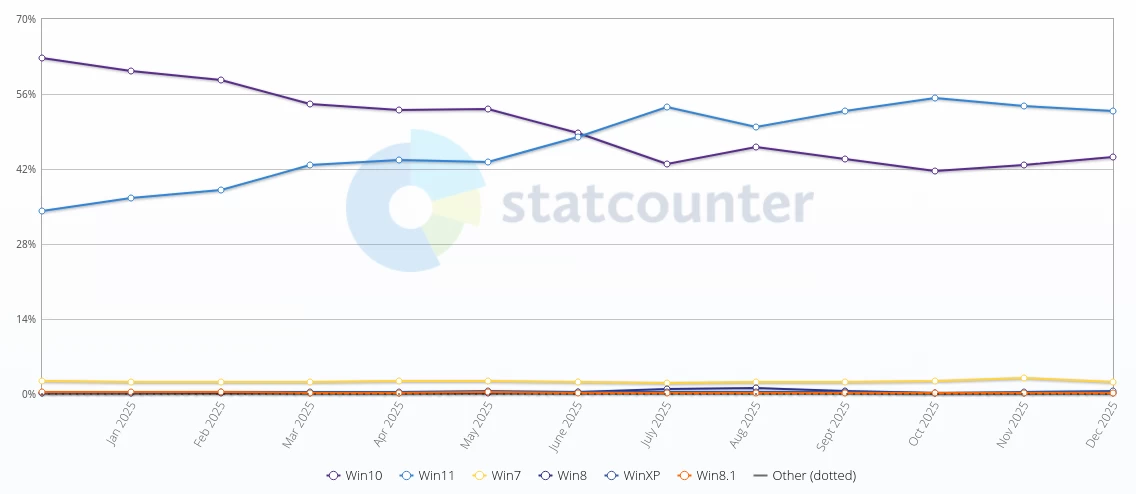
A peculiar thing has happened in this month’s batch of Statcounter data. Windows 11, despite being the only supported version of Windows, has now slipped from 53.7% of market share in November to 51.75% in December. We shouldn’t take Statcounter’s figures as the absolute truth, as its visibility is limited, but it is by far one of the clearest pictures we can get on Windows 11 adoption.
Windows 10, which reached end of life in October, managed to recover ground, rising from 42.7% in November to 44.29% in December. Windows 7 came in at 2.19% and the rest of Microsoft’s operating systems made up insignificant percentages.
The data from Statcounter is quite a bit different from the gamers surveyed by Steam. According to the latest data, Windows 11 increased its market share to 65.59%, up 2.02 points. Windows 10, on the other hand, fell to 29.06%, down 2.08 points.
Zooming out to focus on all Windows versions against other desktop operating systems, we saw Windows decline in December from 69.37% to 66.67%. This is the continuation of a trend we have seen all this year. Back in December 2024, Windows was sitting at 73.38%, so it has fallen quite a long way. Many people say they will move to Linux following the end of Windows 10, but Linux only has 3.18% of the market share.
Another important detail to keep in mind about Windows 10 is that while mainline support has ended, the paid Extended Security Updates (ESU) are still being delivered. This will help to keep businesses holding onto older devices without having to move to Windows 11. It is less likely that many companies would jump to Linux, as Windows is probably required for their necessary apps.
No matter what is going on behind these stats, keep in mind that if you are on Windows 10 without ESU, your system is more and more vulnerable by the day. If your hardware supports Windows 11, you can upgrade to that, but if it doesn’t, then Linux is an option.